Australian & WA Curriculum Alignment
On this page
How our programs align with:
Australian Curriculum
WA Health & Physical Education
WA Science
Presented by a
WA teacher:

Australian curriculum aligned:
Program approved by gynaecologist, endocrinologist, fertility specialist

Australian Curriculum Alignment
HEATLH EDUCATION
SCIENCE
EDUCATION
GENERAL CAPABILITIES
CROSS CURRICULAR
Australian Curriculum:
HPE Focus
Our programs cover strands;
Personal
Social
Community
Focus areas
- Mental health & wellbeing
- Relationships & sexuality
- Food & nutrition
- Health benefits of physical activity
Mental Health & Wellbeing
The content of this program supports students with strategies for emotional awareness and regulation, improve body image, and to support their own mental health and build a network of support
Relationships and Sexuality
The content of this program supports students to develop positive and respectful practices in relation to their reproductive and sexual health and their identities;
Puberty and body changes
Menstrual cycle literacy (including cervical fluid, ovulation, period patterns)
Respectful relationships, boundaries and consent (esp. Senior presentationa Confident Girl Code)
Help-seeking and accessing appropriate health services
Food & Nutrition
The content of this program supports to make healthy, informed food choices and how these are linked to hormones, and their experience of physical, mental and emotional period symptoms
How nutrition influences hormones, mood and period symptoms
Using food to support energy, focus and emotional regulation across the cycle
Health benefits of physical activity
The content of this program supports students to develop knowledge, understanding and skills to make active choices and connects these choices with an impact on heir experience of physical, mental and emotional period symptoms
Safety
Period product safety and hygiene
Online safety and image-based harm in the context of body image and consent (Confident Girl Code)
When and how to seek medical help for menstrual concerns
Australian Curriculum:
Science Focus
Our programs cover strands;
Science Understanding
Science Endeavour
Science Inquiry Skills
Human body systems & life processes
This content brings real-world application to puberty and reproductive system content (e.g. periods, ovulation, menstrual cycle patterns)
Puberty & reproductive development
This content helps students understand how and why their bodies change, what menstruation and ovulation actually are, and how these processes relate to health, emotions and daily life. We connect scientific concepts with practical body literacy—supporting students to recognise normal patterns, ask informed questions, and feel confident navigating puberty and periods.
Cells, hormones & regulation
The content deepens scientific understanding of hormones and regulation by explaining how the endocrine system drives menstrual cycles, mood, sleep, stress responses and symptoms such as pain or PMS. Students learn to link hormonal regulation to real-life data—like tracking patterns, interpreting symptoms, and understanding conditions such as endometriosis or PCOS—building both scientific literacy and self-advocacy.
Scientific thinking about health and evidence-based decision-making
This contet encourages inquiry skills – asking questions, noticing patterns, and using evidence to understand their body
General Capabilities
Literacy
Learning accurate anatomical and menstrual terminology; reading charts; using health language to describe symptoms and ask for help
Numeracy
Hormone and menstrual cycle chart and graph interpretations, correlation and relationships, statistics and percentages
Critical Thinking
Evaluating health information, challenging myths and stigma, and considering options for self-care and support
Personal & Social Capability
Exploring their thoughts, feelings and actions regarding puberty, body image and reproductive health, assessing their personal areas for growth, and planning for growth and improvement in to develop in these areas. Naming needs and feelings, advocating for oneself with doctors/parents/teachers, and supporting peers
Ethical Understanding
Challenging stigma around menstruation, challenges of menstruation that lead to inequality and period poverty and consent in relationships.
Intercultural Understanding
Acknowledging diverse cultural experiences of puberty, menstruation and rites of passage
Cross Curricular
Our programs covers strand;
Sustainability
Sustainability
The program teaches students about reusable period-care options like menstrual cups, period underwear and period swimwear. Students learn how low-waste choices can be inclusive and sustainable. These emerging reusable period products are an example of innovation and creativity in sustainably designed solutions that to reduce present and future impacts on environmental, social and economic systems
WA Curriculum Alignment
Our 'Cycle Wise' programs
HPE Years 4-6
WA CURRICULUM SCOPE & SEQUENCE (2024)
HEALTH & PHYSICAL EDUCATION
Personal, social & community
health
Movement & physical
activity
Personal identity and change
- Puberty, Periods & Emotional changes
- Identity, body image & influences
- Help seeking, body literacy & safety
STRAND: Personal, social & community health
Year 4
- Ways to respond positively to challenges and failures, including the use of resilience and persistence
Changes associated with puberty
Strategies to manage changes associated with puberty
Year 5
- Ways that individuals and groups adapt to different contexts and situations
- Strategies to manage physical, mental/emotional and social changes associated with puberty
Year 6
- Ways that positive self-identities can develop and change over time
- Strategies and resources to understand and manage the physical, mental/emotional, and social changes and transitions associated with puberty
Staying safe
STRAND: Personal, social & community health
Year 4
- Protective behaviours and strategies to remain safe in uncomfortable or unsafe situations
Year 5/6
- Protective behaviours and help-seeking strategies that can be used when students feel unsafe online
- Strategies that promote safety
- Reliable sources of information that inform health and safety decisions:
– internet-based information, publications and other media
– community health organisations
Healthy and active communities
STRAND: Personal, social & community health
Year 4
- Strategies that promote a safe, healthy lifestyle
- Ways in which health information can influence health decisions and behaviours
Year 5
- Strategies that promote a safe, healthy lifestyle
- Health messages that support and maintain an individual’s health, safety and wellbeing
Year 6
- Strategies that promote a safe, healthy lifestyle
- Criteria that can be applied to sources of information, including online to assess their credibility
- Actions that promote and maintain community health, safety and wellbeing
Interacting with others
STRAND: Personal, social & community health
Year 4
Positive influence of respect, empathy, and the valuing of differences in relationships and in society
- Strategies to cope with adverse situations and the demands of others
- Strategies to identify and manage emotions before reacting
Year 5
- Ways in which inappropriate emotional responses impact on relationships
Year 6
Situations in which emotions can influence
decision-making:-with famiy, in peer groups & with friends
Understanding movement
STRAND: Movement & physical activity
Year 4
Benefits of regular physical activity and physical fitness to health and wellbeing
Year 5
- Benefits of regular physical activity and physical fitness to physical, mental and emotional wellbeing
Year 6
- Benefits of regular physical activity and physical fitness to physical, mental and emotional wellbeing
HPE Years 7-10
WA CURRICULUM SCOPE & SEQUENCE (2024)
HEALTH & PHYSICAL EDUCATION
Personal, social & community
health
Personal, social & community
health
Personal identity and change
STRAND: Personal, social & community health
Year 7
Feelings, emotions and cultural beliefs and values associated with transitions; practising self-talk and help-seeking strategies to manage these changes
Ways to manage physical, emotional, and social changes associated with puberty
Year 8
Strategies to cope with and manage the impact of changes and transitions
Year 9
Factors that shape personal identities and adolescent health behaviours
- Strategies for managing changes and transitions
Year 10+ (Senior presentation)
- Impact of societal and cultural influences on personal identities and health behaviour
Staying safe
STRAND: Personal, social & community health
Year 7
- Health information, services and
help-seeking strategies that young people can use in a variety of situations - Protective behaviours and
help-seeking strategies to ensure safety in a variety of situations, including online - Strategies to make informed choices to promote health, safety and wellbeing
Year 8
- Credible health information that can support people in a variety of situations
- Skills and strategies to promote physical and mental health, safety and wellbeing in various environments
Year 9
- Actions and strategies to enhance health and wellbeing in a range of environments
- Strategies are examined, such as communicating choices, seeking, giving and denying consent, and expressing opinions and needs that can support the development of respectful relationships, including sexual relationships
Year 10+ (Senior presentation)
- Analysis of health information and content related to: body image, processed food & relationships
- Strategies are examined, such as communicating choices, seeking, giving and denying consent, and expressing opinions and needs that can support the development of respectful relationships, including sexual relationships
Healthy and active communities
STRAND: Personal, social & community health
Year 7
Strategies to make informed choices to promote health and wellbeing
Preventive health practices for young people to avoid and manage risk
Health and social benefits of physical activity and recreational pursuits
Year 8
- Health promotion initiatives which target relevant health, safety and wellbeing issues for young people and ways to manage them
Year 9
- Implications of attitudes and behaviours on individuals and the community
Year 10+ (Senior Presentation)
Health information, support services and media messaging about relationships, lifestyle choices, health decisions and behaviours
Health promotion designed to raise awareness, influence attitudes, promote healthy behaviours and increase connection to the community
- Social, economic and environmental factors that can influence health
Interacting with others
STRAND: Personal, social & community health
Year 4
Impact of relationships on a person’s wellbeing
- Factors that influence emotional responses and behaviour
Year 8
Strategies for managing the changing nature of peer and family relationships
- Personal, social and cultural factors that influence emotional responses and behaviour
Year 9
Managing emotional responses and resolving conflict in family or social situations
Year 10+ (Senior presentation)
Skills and strategies to promote respectful relationships
- Managing the effects of emotional responses on relationships
Understanding movement
STRAND: Movement & physical activity
Year 7
Impact of regular participation in physical activities on health, fitness and wellbeing
- Strategies to increase physical activity levels
Year 8
- Use of games, recreational activities and outdoor pursuits to enhance activity levels and achieve health and wellbeing outcomes
Year 9
- Use of games, recreational activities and outdoor pursuits to enhance activity levels and achieve health and wellbeing outcomes
Year 10+ (Senior presentation)
- Personalised plans for improving or maintaining physical activity levels to improve health, fitness and wellbeing
Science Years 4-6
WA CURRICULUM SCOPE & SEQUENCE (2024)
SCIENCE
Science understandings
Science as a human endeavour
Science inquiry skills
Biological sciences
STRAND: Science Understanding
Year 4
- Living things have life cycles
Year 5
- Living things have structural features and adaptations that help them to survive in their environment
Year 6
- The growth and survival of living things are affected by physical conditions of their
environment
Nature and development of science
STRAND: Science as a human endeavour
Year 4
- Science involves making predictions and describing patterns and relationships
Year 5/6
- Science involves testing predictions by gathering data and using evidence to develop explanations of events
Use and influence of science
STRAND: Science as a human endeavour
Year 4
- Science knowledge helps people to understand the effect of their actions
Year 5/6
- Scientific knowledge is used to solve problems and inform personal and community decisions
Processing and analysing data and information
STRAND: Science inquiry skills
Year 4
Use a range of methods including tables and simple column graphs to represent data and to identify patterns and trends. Compare results with predictions, suggesting possible reasons for findings
Year 5/6
- Construct and use a range of representations, including tables and graphs, to represent and describe observations, patterns or relationships in data
Compare data with predictions and use as evidence in developing explanations
Science Years 7-10
WA CURRICULUM SCOPE & SEQUENCE (2024)
SCIENCE
Science understandings
Science as a human endeavour
Science inquiry skills
Biological sciences
This content connects to: reproductive organs, ovulation, menstruation, and fertility awareness as body literacy.
STRAND: Science Understanding
Year 7/8
- Cells are the basic units of living things with specialised structures and functions.
- Multi-cellular organisms contain systems of organs carrying out specialised functions that enable them to survive and reproduce
- Body systems (including endocrine and nervous) coordinate and regulate responses to internal and external changes.
Year 9/10
- Multi-cellular organisms rely on coordinated and interdependent internal systems to respond to changes to their environment
- Body systems (including endocrine and nervous) coordinate and regulate responses to internal and external changes.
• Scientific knowledge informs personal and community decisions about health. - Reproductive cells and organs enable sexual reproduction and continuation of species.
- Scientific understanding influences decisions about sexual and reproductive health.
Nature and development of science
This content relates to current research of menstrual blood and the research into women’s reproductive health and disease.
STRAND: Science as a human endeavour
Year 7/8
- Scientific knowledge has changed peoples’ understanding of the world and is refined as new
evidence becomes available
Year 9/10
- Advances in scientific understanding often rely on technological advances and are often linked
to scientific discoveries
Use and influence of science
This content relates to past inequalities in women’s health research and funding, which has lead to a current focus on women’s health issues.
STRAND: Science as a human endeavour
Year 7/8
- People use science understanding and skills in their occupations and these have influenced the
development of practices in areas of human activity
Year 9/10
- Values and needs of contemporary society can influence the focus of scientific research
Processing and analysing data and information
STRAND: Science inquiry skills
Year 7/8
Construct and use a range of representations, including graphs, keys and models to represent
and analyse patterns or relationships in data using digital technologies as appropriateSummarise data, from students’ own investigations and secondary sources, and use scientific
understanding to identify relationships and draw conclusions based on evidence
Year 9/10
- Analyse patterns and trends in data, including describing relationships between variables and
identifying inconsistencies - Use knowledge of scientific concepts to draw conclusions that are consistent with evidence
Enquire for your school
"My daughter said that the workshop had just the right mix of fun and real talk" - Parent feedback
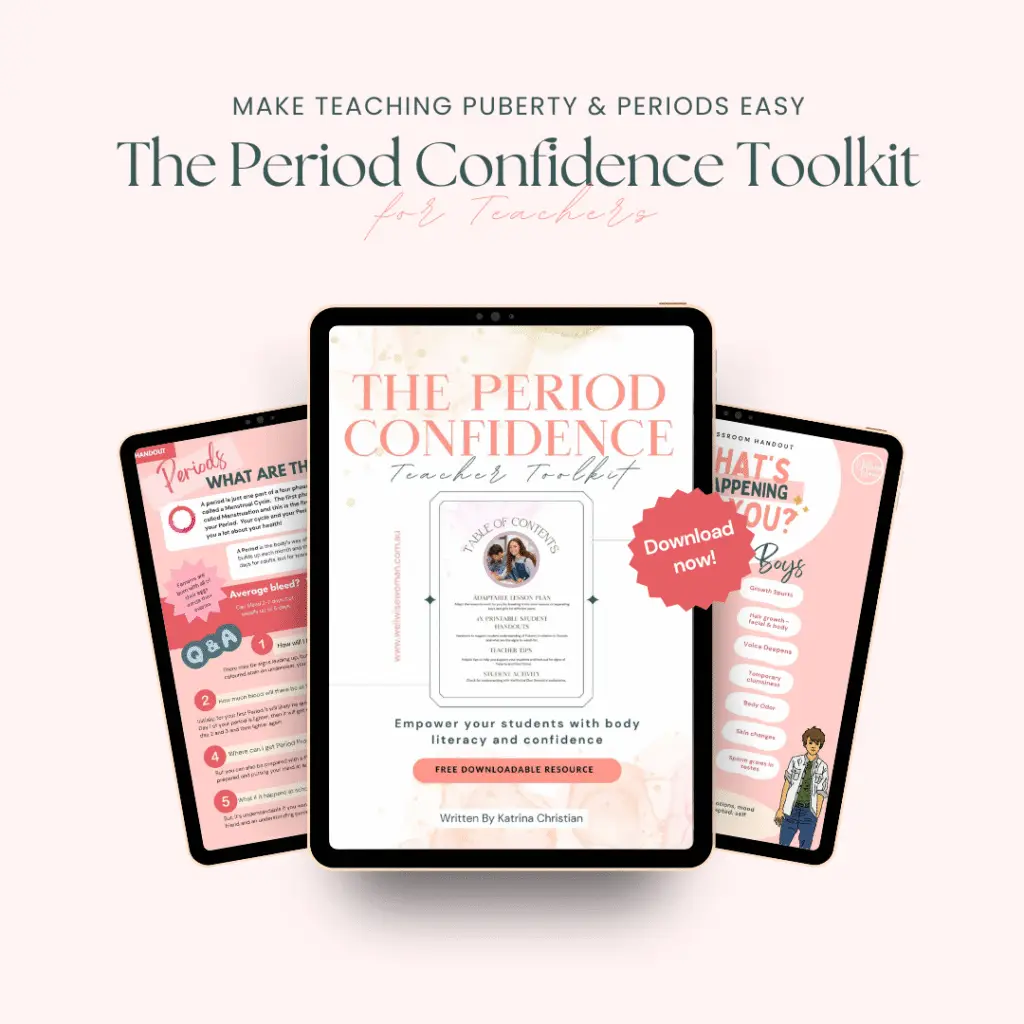
Free classroom workbook
'Period confidence toolkit'
Printable activity sheets
to cover periods in your classroom
Meet Katrina Christian
Founder, Teacher & Menstrual Health Educator
With years of experience working in schools (and raising a tween and a teen herself), Katrina knows just how powerful it is when girls are taught to trust their bodies. She specialises in girls’ wellbeing, with a focus on the knowledge, wisdom, and power of the menstrual cycle.
Her presentations are real, honest, and empowering—because confidence starts with understanding.